




If you drive anywhere near commercial semi-trucks or large buses, understanding how to safely share the road with them is critical to protecting yourself and your passengers. One of the most important concepts to master is the “No-Zone.”
In driving, the “No-Zone” refers to the massive blind spots that exist around large commercial vehicles where smaller passenger cars completely disappear from the truck driver’s field of vision. Because these commercial rigs lack rearview mirrors and rely entirely on side mirrors, hanging out in these zones significantly increases the risk of a severe truck accident.
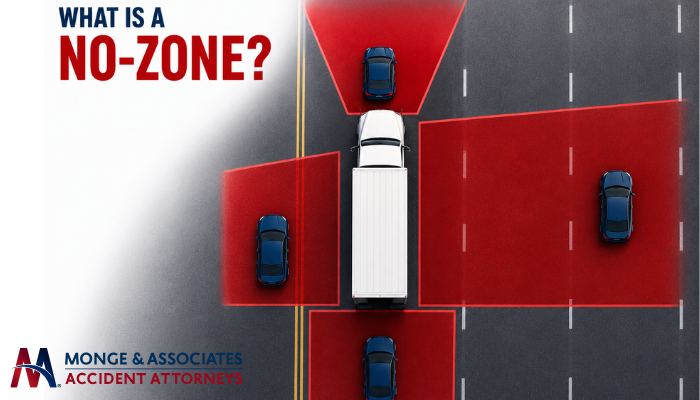
The 4 Main No-Zones
The Federal Motor Carrier Safety Administration (FMCSA) has launched major safety campaigns outlining four distinct commercial vehicle blind spots where motorists face the highest level of danger.
1. The Front Blind Spot
Location: Directly in front of the truck cab.
A semi-truck’s massive hood creates a forward blind spot that extends up to 20 feet ahead of the bumper. When a car passenger zips into the lane directly in front of a rig and immediately slows down, the truck driver literally cannot see them. Because heavy commercial vehicles require much more time and distance to come to a complete stop, cutting into the front No-Zone makes a devastating rear-end collision highly probable.
2. The Rear Blind Spot
Location: Directly behind the trailer.
Unlike standard passenger vehicles, commercial trucks do not have a rearview mirror inside the cab. Their rear blind spot typically extends at least 30 feet backward, and can stretch up to 200 feet depending on the trailer size. Tailgating a truck in this zone is incredibly risky—the truck driver has no idea you are there, and you lose your ability to spot hazards, debris, or sudden braking on the road ahead.
3. The Right-Side Blind Spot
Location: Alongside the right of the truck cab, stretching outward across multiple traffic lanes.
This is the largest and most dangerous No-Zone on the entire vehicle. Commercial trucks require incredibly wide swings to navigate turns safely. If you attempt to pass or linger on the right side of a truck when it is maneuvering a wide right turn, you run a severe risk of being squeezed or crushed between the truck’s trailer and the curb.
4. The Left-Side Blind Spot
Location: Just behind the driver’s side door, extending backward along the length of the trailer.
While the left side offers slightly better visibility for the truck driver than the right side, it is still a substantial blind spot. A standard passenger vehicle can easily vanish from the driver’s side mirrors when passing through this zone.
Quick Safety Rules to Protect Yourself
To minimize your risk of an underride crash or a blind-spot collision, keep these standard truck safety rules in mind whenever you are on the highway:
- The Mirror Rule: If you cannot see the truck driver’s face or their side-view mirrors, the truck driver cannot see you.
- The Pass Rule: Always pass large commercial rigs entirely on the left side where visibility is better. When passing, make sure you can see the entire front of the truck cab in your rearview mirror before signaling and pulling back into their lane.
- The Turn Rule: Never attempt to squeeze past or pass a truck on the right side if the driver has their right-hand turn signal flashing.
Talk to a Truck Accident Lawyer at Monge & Associates Today
When a passenger vehicle gets caught in a commercial rig’s No-Zone, the resulting injuries are rarely minor. Heavy commercial trucks can weigh up to 80,000 pounds, meaning a collision can alter your life in an instant. Because you want to win your recovery and hold negligent trucking corporations accountable, you need an experienced advocate on your side.
If you or a loved one was injured in a truck accident, contact our Atlanta truck accident lawyer today for a free, no-pressure case evaluation. We will fight to protect your rights and maximize your financial compensation.